
The Penis, Testicles and Other Bits📝👨⚕️
Penis facts and health 📝
📏Size:
Just as everyone is a different height and has different hair, all penises come in slightly different shapes and sizes. The average penis size, once fully formed in adulthood, will be about 9cm when not erect and around 15cms when erect. There are not any average sizes for the teenage penis as young people all grow at different rates. Find out more about this (HERE) and (HERE).
🛀Hygiene:
It is important to wash the penis each day with warm water while in the shower of bath, pulling the foreskin back and cleaning underneath it. If this area is not kept clean, a build up of smegma ( a cheesy looking substance) can build up and start to smell.
The glans or head of the penis
This is a really sensitive part of the penis because it’s packed with so many nerve endings. It’s very similar to the glans of the clitoris. Even without very much foreskin this area is still very sensitive. People who have been circumcised may find they might like to use lubricant to keep the skin moist and sensitive. Condoms can also help to act as kind of replacement foreskin too.
Foreskin
Your foreskin should eventually, as you go through puberty, be able to move forwards and backwards over the glans, or head, of the penis. This often happens naturally during puberty as the penis grows and through masturbation.
You also need to be able to clean under the foreskin to prevent infection.
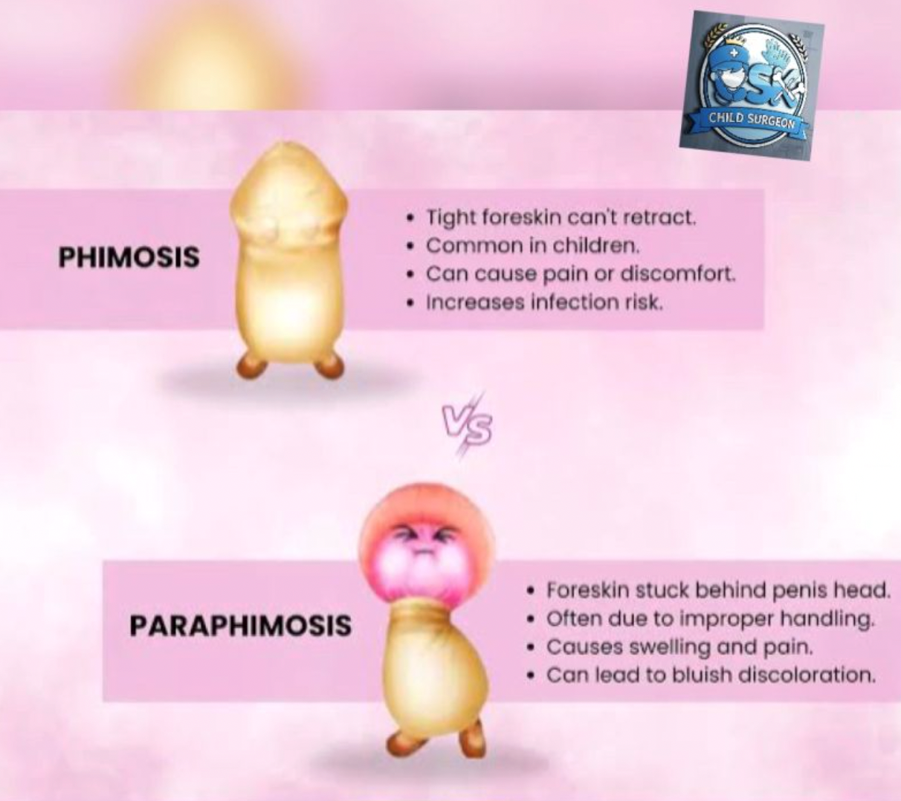
Phimosis (tight foreskin)
Phimosis is when the foreskin of the penis can’t be pulled back over the glans, or head, of the penis. This is normal before you have gone through puberty.
A tight foreskin after puberty can increase the risk of infection or skin problems if you aren’t able to clean the head of the penis properly. This is particularly a problem if the opening of your urine tube (urethral meatus) is covered as urine can get stuck under the skin. It can also be difficult when you become sexually active as it can cause pain or discomfort.
Try stretching the foreskin forward and then backwards as far as it will go, hold it for a few seconds and then let go and repeat. It might help to do this in the bath or shower as the warm water will help to stretch the skin. Little by little over a few weeks the hole (prepuce) will get bigger and so the foreskin should slide over the glans more easily. Only do this if it is comfortable and be careful that it doesn’t get stuck (try and move it back straight away or go to a doctor). If in any doubt see your doctor, who may prescribe something to help loosen it or in very extreme circumstances recommend circumcision (removal of the foreskin).
Paraphimosis
Paraphimosis is the opposite of phimosis, in this scenario the foreskin has been pulled back and can’t be brought forward again over the glans. This can cause swelling, pain and changes in colour of the penis. This needs to be seen by a doctor urgently as it can cause the end of your penis to become damaged due to affecting the blood flow. This needs to be treated urgently, in some rare cases by a small operation.
What is circumcision?🤔
This is a small straight forward operation to remove the piece of skin that covers the end of the penis. It can be done for religious reasons or because your foreskin will not retract back. It should not affect your ability to have sex.
What is the spot on my penis?🤔
There are several reason you may have spots on your penis and most are harmless.
- Pearly penile papules: These are small skin coloured lumps usually found on the head of the penis. They usually go all the way round the head and often appear in two rows. They are normal and do not need to be treated.
- Fordyce spots: These are small yellowish/white spots found on the head or shaft of the penis, they are small sebaceous glands, normal and need no treatment.
- Lymphocele: This is a hard swelling that suddenly appears on the shaft of the penis after sex or masturbation, it will soon disappear and cause not problems
- Genital Warts: This is an STI, they are small fleshy bumps that can appear anywhere around the genital area and anus. They require treatment at a sexual health clinic.
- Sores or ulcers: These are painful blisters or sores on the penis, can be caused by the Herpes virus, another STI infection that requires a visit to the sexual health clinic.
- Molluscum contagiosum: This is a viral infection, causing small raised spots not dissimilar to white heads. They are pretty harmless and usually disappear on their own eventually.
Is it normal to masturbate ?🤔
It is totally normal to masturbate, and this often increases during puberty. It can be a great way to relax, get sexual pleasure and also to discover your body and how it works.
Erections
It is normal to get erections when you wake up in the morning. It is equally normal to have erections throughout the day, this is due to a high level of the hormone testosterone being about in your body during puberty.
Ejaculating quickly when either masturbating or having sex when you are young is very common due to feeling nervous or over excited. Most do not worry about it and it usually settles as you become more experienced. Using a condom can help this situation.
It can be difficult to get an erection soon after you have ejaculated, most males have to wait a little while before the penis can become erect again.
What is sperm?🤔
Sperm are produced in the testicles, they are ejaculated from the penis in fluid called semen. Each ejaculation (or, The ejaculate) can contain over 100million sperm. It only takes one to get someone pregnant so it is important to use a condom. Pre-cum, which is the fluid produced prior to ejaculation also contains sperm. If the condom bursts during sex it is important to let your partner know so they can access emergency contraception, to help prevent a pregnancy.
It is always important to discuss contraception and condoms, this makes for a healthy relationship
If your partner is not yet 16 years old then be aware of sex and the law
Young people are sometimes tempted to look or exposed to pornography, and often get unrealistic ideas about sex and relationships. It’s worth knowing that there are laws around under 18’s accessing porn and websites should have safeguarding measures in place.
The Testes (balls)
Testes, or testicles, is the proper name for your balls. They sit inside your scrotum (ball sack). These organs are important because they make and store your sperm which is needed for reproduction in later life. They also make testosterone which is the hormone that helps with puberty, builds muscle, deepens your voice and causes body hair to grow.
Testicular Torsion (Twisting of the testicle)
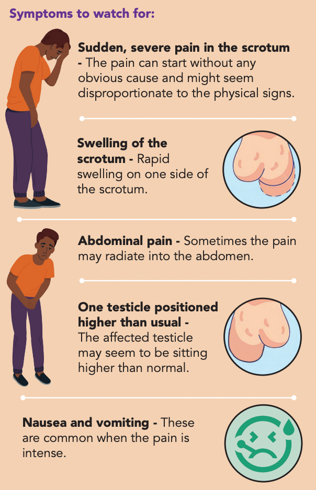
Testicular torsion is when the testicle and the cord that join your testes to your body get twisted. This is an emergency because the cord contains a blood vessel and so the twisting cuts off the blood supply. The longer this goes on the more damage can happen to the testicle. If it is testicular torsion a doctor needs to untwist it urgently.
Symptoms:
- Severe pain in on of your testicles, which usually happens suddenly
- You might feel sick or even vomit
- The pain can sometimes be felt in the lower tummy
- The scrotum might look red or swollen
- One testicle might look like its sitting in a funny position
It is so important if you have any of the following symptoms that you tell a responsible adult and get medical attention as soon as possible. Not all of the symptoms have to happen for it to be testicular torsion.
You should never wait to see if the pain gets better! Always tell a responsible adult. After 12 hours, the risk of losing the testicle becomes much higher.
Testicular Lumps
Finding a lump in a testicle can be worrying, but many testicular lumps are not serious. Some lumps are caused by harmless conditions, such as fluid-filled cysts, infection or a build-up of fluid around the testicle (a hydrocele).
However, some lumps can be a sign of testicular cancer, which is the most common cancer in young men aged 15–35. Getting to know what is normal for your body is important and you can do this by regularly checking your testicles.
If you notice anything unusual, it’s important to see your GP. Most changes are not cancer, but getting checked early gives you reassurance and, if treatment is needed, leads to the best outcomes. Over 95% of cases of testicular cancer can be successfully treated, especially if picked up early.
Things to look out for:
- A hard lump
- Swelling
- Change in size
- Feeling heavier than normal
It doesn’t matter if the lump isn’t painful – most testicular cancers don’t cause pain!
Some risk factors for testicular cancer include
- A history of testicular cancer in your family, especially a brother or father
- Young, white men
- Some conditions such as having an undescended testicle when born or other genetic conditions
- Some infections including HIV
How to examine your testes
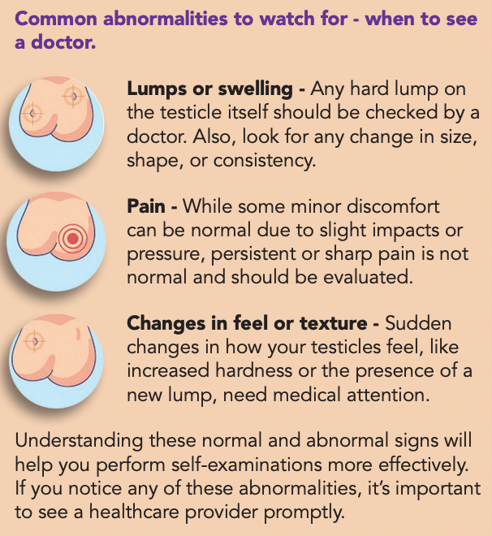
Regularly examining your testicles helps you spot any changes early on. It’s a really good idea to examine your testicles once a month to get used to what ‘normal’ feels like for you and to make sure you notice any changes such as a lump, swelling, pain, a feeling of heaviness or changes in size. It only takes about a minute to check your testicles.
It is best to do this after a warm shower when the scrotum is most relaxed. By the way, it is normal for one testicle to hang lower than the other but not if this happens all of a sudden or with pain. It is also normal to notice a soft tube at the back of the testicle – this is called the epididymis.
So, in summary
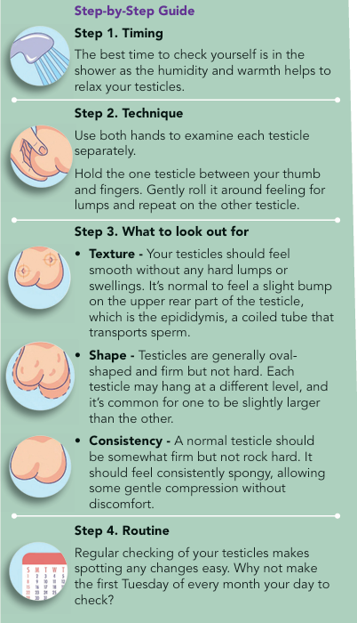
- You should never be embarrassed to tell a responsible adult or medical professional if you notice something different about your testicles or you’re experiencing symptoms involving your testicles
- Most problems with your testicles can be dealt with really effectively if they are treated quickly
- Checking your testicles regularly (once a month) is a really important part of this because then you will know what is normal for you and will quickly realise if something is different.
- Most testicular lumps are not cancer but should always be seen by a medical professional
- Sudden pain = an emergency
For more information click HERE.
MOOBS (breast tissue enlargement)
During puberty hormone levels vary. If the level of testosterone drops, oestrogen can cause breast tissue to grow. Many teenagers have some degree of breast enlargement. This condition at puberty usually clears up as people with a penis get older and their hormone levels become more stable.
